
For years I assumed my neck pain and upper back pain were simply caused by “tight muscles”.
Like many people suffering with:
pain between shoulder blades,
I spent years focusing on:
stretching,
massage,
foam rolling,
and temporary symptom relief.
But the pain always seemed to return.
What eventually started changing things for me personally was not endlessly treating the painful area itself… but improving the way my shoulders, upper back and thoracic spine actually moved.
The Wall Test That Changed Everything
“Many people with pain between shoulder blades also struggle with restricted thoracic movement.”
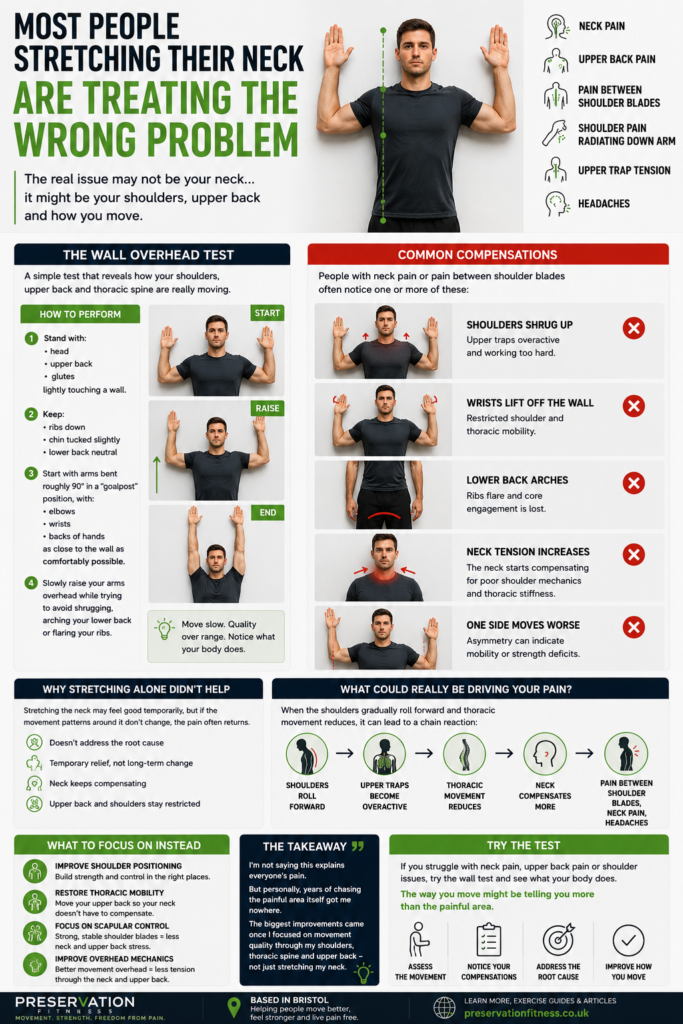
One of the most revealing things I discovered was a simple wall overhead movement test.
At first glance it looks easy.
But many people with:
rounded shoulders,
neck pain,
thoracic stiffness,
or shoulder mechanics problems
struggle badly without realising it.
How To Perform The Test
Stand with:
head,
upper back,
and glutes lightly touching a wall.
Keep:
ribs down,
chin tucked slightly,
and lower back neutral.
Start with arms bent roughly 90 degrees in a “goalpost” position, with:
elbows,
wrists,
and backs of hands
as close to the wall as comfortably possible.
Then slowly raise the arms overhead while trying to avoid:
shrugging shoulders,
arching the lower back,
or ribs flaring outward.
Common Compensations
People suffering with neck pain or pain between shoulder blades often notice:
shoulders shrugging upward,
wrists lifting away from the wall,
neck tension increasing,
upper back stiffness,
or one side moving worse than the other.
In my case, the more my right shoulder gradually rolled forward over time, the worse my upper back and neck symptoms became.
Why Stretching Alone Didn’t Help Me
This was the interesting part.
I could stretch my neck constantly and still feel:
upper trap tightness,
shoulder blade pain,
and recurring stiffness through the upper back.
What personally made a far bigger difference was improving:
scapular control,
thoracic movement,
shoulder positioning,
overhead mechanics,
and movement capacity.
That doesn’t mean everybody’s pain has the same cause.
But it does suggest that many people may be focusing entirely on the painful area itself while ignoring the movement patterns surrounding it.
Pain Between Shoulder Blades And Shoulder Mechanics
One thing many people do not realise is how connected the neck, shoulder blades and thoracic spine really are.
When the shoulders gradually roll forward:
the upper traps often become overactive,
thoracic movement can reduce,
overhead mobility becomes restricted,
and the neck can begin compensating constantly.
Over time this may contribute to:
backache between shoulder blades,
neck tightness,
shoulder pain radiating down arm,
and chronic upper back tension.
Final Thoughts
I am not claiming this explains everybody’s symptoms.
But personally, years of chasing the painful area itself got me nowhere.
The biggest improvements came once I started restoring movement quality through the shoulders, thoracic spine and upper back instead of simply stretching the neck over and over again.
If you struggle with:
pain between shoulder blades,
shoulder pain radiating down arm,
neck stiffness,
or upper back tightness,
try the wall test shown in the video and pay attention to what your body does to compensate.
Sometimes the movement pattern itself reveals more than the painful area.
Related Reading
Shoulder Pain Radiating Down Arm
Thoracic Mobility Exercises
