
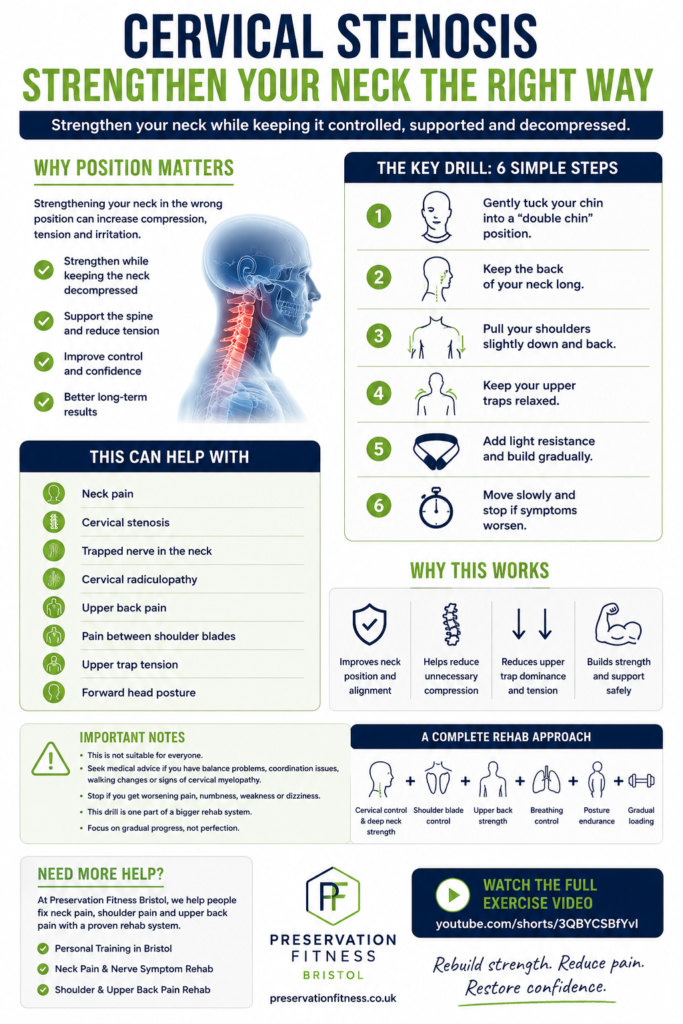
Strengthen Your Neck Without Compressing It
Cervical Stenosis Exercises: Why Position Matters
If you have neck pain, cervical stenosis, a trapped nerve in the neck, or symptoms that travel into the shoulder, arm or hand, one of the biggest mistakes is trying to strengthen the neck while accidentally compressing it.
In my latest video, I demonstrate a simple cervical spine strengthening drill where the aim is not just to “work the neck”.
The real goal is to build strength while keeping the neck controlled, long and as decompressed as possible.
That means:
chin gently tucked
shoulders slightly down and back
upper traps kept quiet
neck long, not jammed
slow controlled effort
no aggressive straining
This is the type of detail that matters when you are dealing with long-term neck pain, cervical stenosis, cervical radiculopathy, upper trap tension or nerve-type symptoms from the neck.
At Preservation Fitness Bristol, I use rehab-focused personal training to help people improve strength, movement and confidence without just throwing random exercises at the problem.
What Is Cervical Stenosis?
Cervical stenosis means there is narrowing in part of the neck, usually around the spinal canal or nerve spaces.
For some people, this can contribute to symptoms such as:
neck pain
stiffness
shoulder tension
nerve pain into the arm
tingling or numbness
weakness
symptoms that feel worse in certain neck positions
Not every case is the same, and not every person with cervical stenosis will have the same symptoms.
But from a rehab point of view, one thing is very important:
You do not want to strengthen the neck by jamming it into more tension and compression.
That is why position matters.
You can learn more about my local neck pain approach here:
Neck Pain Bristol: Fix the Real Cause
The Problem With Most Neck Exercises
A lot of people are told to do basic neck pain exercises.
The problem is that many people perform them while:
shrugging the shoulders
clenching the jaw
bracing too hard
pushing the head forward
tensing the upper traps
compressing the neck
forcing through discomfort
This can make the neck feel tighter, heavier and more irritated.
That is especially important if you are dealing with cervical stenosis, cervical radiculopathy, or nerve pain from the neck into the arm.
The goal should not be to just make the neck “work harder”.
The goal should be to teach the neck, shoulders and upper back to work together better.
That is why I often say:
Don’t just strengthen the neck. Strengthen it in a position your body can actually tolerate and control.
The Key Drill: Chin Tuck, Shoulders Down, Neck Long
In the video, the basic setup is:
Gently tuck the chin into a “double chin” position
Keep the back of the neck long
Pull the shoulders slightly down and back
Keep the upper traps quiet
Add controlled resistance
Move slowly
Stop if symptoms worsen
The chin tuck helps bring the head back into a better position.
The shoulder position helps stop the upper traps from taking over.
The controlled resistance helps strengthen the cervical spine without turning the exercise into a tense, aggressive strain.
This is especially useful for people who feel like their neck and shoulders are constantly switched on.
Why Shoulder Position Matters for Neck Pain
Your neck does not work in isolation.
The cervical spine is heavily influenced by the upper back, shoulder blades, rib cage and posture.
If your shoulders are constantly shrugged, rounded or pulled forward, the neck often has to work harder.
That can contribute to:
upper trap tightness
neck stiffness
pain between the shoulder blades
headaches
shoulder pain
nerve irritation
poor posture
reduced confidence with exercise
This is why my rehab approach does not just look at the neck.
I also look at the shoulders, shoulder blades and upper back.
That links closely with another important area: scapular control.
How Scapular Depression Links to Neck Pain
Scapular depression means gently learning how to control the shoulder blade down, rather than letting the shoulder constantly hike up towards the ear.
This matters because a lot of people with neck pain and shoulder pain do this:
They move the arm → the shoulder shrugs → the upper trap takes over → the neck tightens → symptoms increase.
For someone with cervical stenosis or nerve-type neck symptoms, constantly shrugging can make the neck feel more compressed.
That does not mean scapular depression is a magic fix.
But it can be a useful control skill inside a bigger rehab system.
It may help teach:
better shoulder blade control
less upper trap dominance
more upper back support
improved shoulder mechanics
reduced neck tension
better movement confidence
This also links into shoulder rehab, especially for people who have both neck pain and shoulder pain.
You can read more about shoulder pain and lifting here:
Shoulder Pain When Lifting Arm? Bristol Shoulder Rehab Guide
Neck Pain and Pain Between the Shoulder Blades
Many people who search for neck pain exercises also complain of pain between the shoulder blades or upper back tension.
This is not surprising.
The neck, upper back and shoulder blades are all connected mechanically.
If the upper back is stiff, the shoulder blades lack control, or the neck is doing too much work, pain can often show up between the shoulder blades.
Common contributing factors can include:
poor shoulder blade control
weak upper back muscles
stiff thoracic spine
forward head posture
desk posture overload
upper trap dominance
shallow breathing
poor pulling mechanics
That is why a full rehab system should not only focus on the painful spot.
It should look at the whole system that supports the neck and shoulders.
For more on upper back and shoulder-related issues, you can also visit:
Shoulder Problems Exercises Stockwood Bristol
Why Cervical Stenosis Rehab Needs to Be Gradual
If you have cervical stenosis, trapped nerve symptoms or cervical radiculopathy, you should not jump straight into aggressive strengthening.
A better approach is usually gradual.
That may include:
gentle positional control
chin tuck progressions
deep neck flexor strengthening
shoulder blade control
upper back strengthening
breathing control
postural endurance
progressive loading
careful symptom monitoring
The aim is not to force the neck into submission.
The aim is to build capacity.
In simple terms:
You want the neck to feel better supported, not more threatened.
When Neck Strengthening May Not Be Suitable
Neck exercises are not suitable for everyone.
You should seek medical advice before trying neck strengthening if you have:
worsening numbness
worsening weakness
balance problems
walking changes
loss of coordination
symptoms in both arms or legs
bladder or bowel changes
severe unexplained pain
recent trauma
chest pain
breathing trouble
suspected cervical myelopathy
This is important.
My approach is rehab-focused personal training, not emergency medical care.
If symptoms suggest something more serious, you need proper medical assessment.
How This Fits Into the Preservation Fitness Rehab System
At Preservation Fitness Bristol, I do not believe in just giving people random exercises.
The aim is to rebuild the system that supports the painful area.
For neck pain, cervical stenosis and nerve-type symptoms, that may involve:
improving cervical control
strengthening the deep neck muscles
improving shoulder position
reducing upper trap dominance
building upper back strength
improving posture endurance
restoring confidence with movement
For shoulder pain, the same principle applies.
The shoulder does not work properly without good control from the shoulder blade, rotator cuff and upper back.
That is why my shoulder programme focuses on rebuilding the whole shoulder support system, not just stretching the painful area.
You can see the shoulder programme here:
12-Week Shoulder & Upper Back Pain Fix
Local Neck Pain and Shoulder Rehab in Bristol
If you are looking for a Bristol PT, fitness trainer Bristol, or a rehab-focused personal trainer who understands neck, shoulder and upper back pain, Preservation Fitness Bristol is based around helping people rebuild strength safely.
This may be suitable if you are dealing with:
neck pain
cervical stenosis
trapped nerve neck symptoms
cervical radiculopathy
nerve pain arm from neck
upper back pain
shoulder pain when lifting arm
pain between shoulder blades
rotator cuff irritation
degenerative shoulders
poor posture
long-term stiffness
You can see my main services here:
Personal Training Services in Bristol
Or visit the homepage here:
Final Thoughts
If you have neck pain or cervical stenosis, exercise can be useful — but only if it is done with control.
The aim is not to force your neck through pain.
The aim is to strengthen the cervical spine while improving position, support and confidence.
That means learning how to:
tuck the chin gently
keep the neck long
control the shoulders
reduce upper trap dominance
build upper back support
strengthen gradually
avoid compressive, aggressive movement
This is why I focus on rehab-based personal training rather than generic exercise sheets.
Because with neck pain, shoulder pain and upper back pain, the painful area is often only one part of the bigger picture.
Don’t just chase the pain. Rebuild the system that supports it.
FAQ Section
What is the best exercise for cervical stenosis?
There is no single best exercise for everyone with cervical stenosis. A good starting point is often gentle cervical control work, such as chin tuck progressions, combined with upper back and shoulder support exercises. The best exercise depends on your symptoms, strength, posture and tolerance.
Can neck strengthening help cervical stenosis?
Neck strengthening may help some people by improving support, control and confidence. However, it needs to be done gradually and carefully. If strengthening causes worsening numbness, weakness, arm pain, balance problems or coordination issues, stop and seek medical advice.
What is a chin tuck?
A chin tuck is a gentle movement where you draw the chin slightly backwards, as if making a small double chin. The aim is to lengthen the back of the neck and improve cervical control, not to force the head down aggressively.
Why do my shoulders shrug when I do neck exercises?
Many people overuse the upper traps when doing neck or shoulder exercises. This can cause the shoulders to hike up towards the ears. Learning to keep the shoulders slightly down and relaxed can help reduce unnecessary neck tension.
Can cervical stenosis cause arm pain?
Yes, cervical stenosis can sometimes contribute to nerve irritation that causes symptoms into the shoulder, arm or hand. This may be described as cervical radiculopathy, trapped nerve symptoms, tingling, numbness or nerve pain from the neck into the arm.
Is pain between the shoulder blades linked to neck pain?
It can be. Pain between the shoulder blades may be linked to upper back stiffness, shoulder blade control, neck tension, posture, breathing mechanics or weakness in the muscles that support the spine and shoulders.
Should I exercise if I have nerve pain from my neck?
It depends on the severity and type of symptoms. Gentle rehab may help some people, but worsening numbness, weakness, coordination issues, walking problems or signs of cervical myelopathy should be assessed medically before exercising.
Can a personal trainer help with neck pain?
A rehab-focused personal trainer can help with strength, posture, movement control and confidence, especially when neck pain is linked to weakness, poor movement habits or lack of support from the upper back and shoulders. However, serious neurological symptoms need medical assessment.
Do you help people with neck pain in Bristol?
Yes. Preservation Fitness Bristol offers rehab-focused personal training for people dealing with neck pain, shoulder pain, upper back pain and long-term movement issues.
