
Shoulder Pain When Lifting Your Arm in Bristol?
Specialist Shoulder Rehabilitation in Stockwood, Bristol
Do you get shoulder pain when lifting your arm?
Maybe it hurts when you reach overhead, put on a coat, lift a kettle, reach into a cupboard, wash your hair, or try to sleep on that side.
For many people, shoulder pain starts as a small irritation. Then, over time, simple daily movements become painful, frustrating and unpredictable.
At Preservation Fitness Bristol, I help people with shoulder pain when lifting the arm rebuild strength, confidence and control through structured, progressive rehabilitation.
I am based in Stockwood, Bristol, and I work with people across BS14, Brislington, Knowle, Hengrove, Whitchurch, Bedminster, Keynsham, Longwell Green and South Bristol.
I have spent 10 years helping people with shoulder pain, especially people who struggle to lift their arm because of rotator cuff weakness, shoulder impingement symptoms, poor movement control, old injuries, physical jobs, gym-related shoulder pain or long-term irritation that keeps coming back.
This is not a quick stretch, a printout, or a generic physio-style exercise sheet.
This is personalised shoulder rehabilitation designed to help you understand what is going on, rebuild strength safely, and get back to using your arm properly again.
Book your shoulder pain assessment in Bristol today.
Shoulder Pain When Lifting Your Arm: What It Often Feels Like
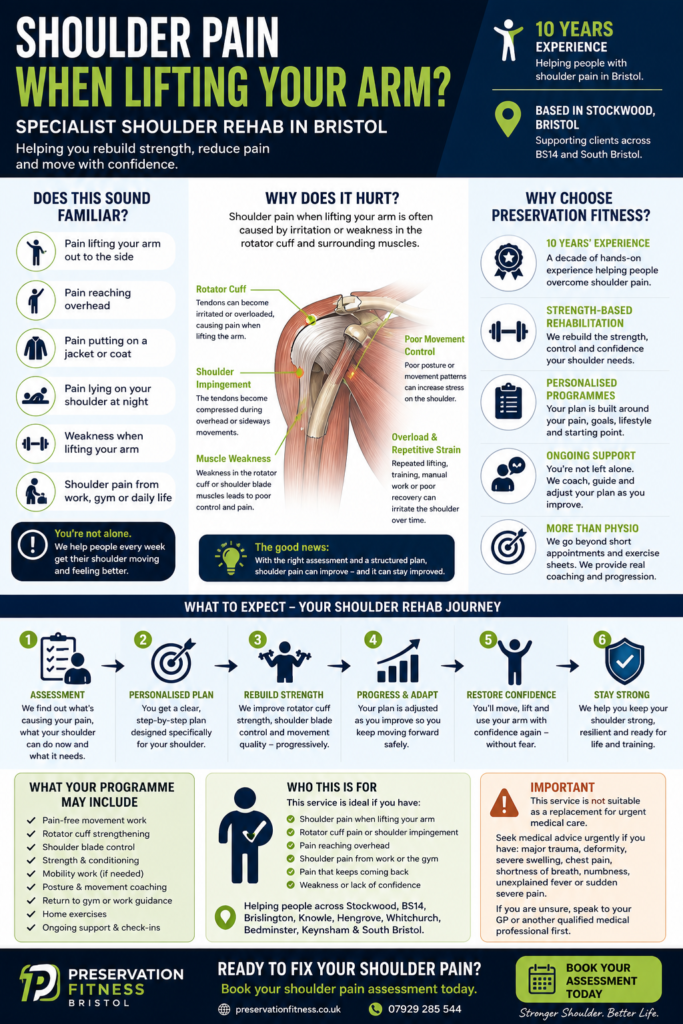
People usually come to me when they are dealing with one or more of these problems:
Sharp shoulder pain when lifting the arm sideways
Pain when reaching overhead
Pain when putting on a jacket or coat
Pain when reaching behind the back
Pain when lying on the affected shoulder
Weakness when lifting the arm
Pain lifting weights in the gym
Shoulder pain after work, DIY, lifting, decorating or manual labour
Pain that improves with rest but comes back again
A shoulder that feels weak, unstable or unreliable
A lot of people describe it as:
“My shoulder hurts when I lift my arm.”
“I can lift it part of the way, then it catches.”
“It feels weak when I reach out to the side.”
“I get pain at night when I sleep on it.”
“I’ve tried resting it, but it keeps coming back.”
If that sounds familiar, you are exactly the type of person this service is built for.
Why Your Shoulder May Hurt When You Lift Your Arm
The shoulder is one of the most mobile joints in the body. That mobility is useful, but it also means the shoulder relies heavily on muscle strength, tendon capacity, shoulder blade control and good movement patterns.
A common reason people get pain when lifting the arm is rotator cuff related shoulder pain.
The rotator cuff is a group of muscles and tendons that helps control and stabilise the shoulder joint. When these tissues become irritated, overloaded, weak or poorly coordinated, lifting the arm can become painful.
This is sometimes described as:
Rotator cuff pain
Shoulder impingement
Tendon irritation
Rotator cuff tendinopathy
Shoulder bursitis
Shoulder weakness
Painful arc
The NHS explains that shoulder impingement can cause pain when raising the arm, and that physiotherapy exercises may help improve movement and reduce pain. NICE also describes physiotherapy for rotator cuff disorders as including postural correction, motor control retraining, stretching, and strengthening of the rotator cuff and shoulder blade muscles.
That is exactly where proper strength-based rehabilitation becomes important.
The Big Mistake: Resting Too Long and Hoping It Goes Away
Rest can help calm pain down in the short term, especially if your shoulder has been overloaded.
But rest alone rarely rebuilds the strength, control and confidence your shoulder needs.
Many people get stuck in the same cycle:
Shoulder hurts
They rest it
Pain improves slightly
They use the arm again
Pain comes back
They avoid more movement
The shoulder gets weaker
The problem becomes more frustrating
This is why shoulder pain often needs a structured plan.
Not random exercises.
Not “just stretch it.”
Not a sheet of exercises you forget about after a week.
You need a progressive approach that starts where your shoulder is now and gradually builds your capacity back up.
Why Strength Training Is Often the Missing Piece
Many shoulder problems improve when the right exercises are progressed at the right pace.
NHS shoulder rehabilitation guidance commonly includes progressive movement and strengthening exercises for rotator cuff related shoulder problems. The British Elbow & Shoulder Society also provides shoulder pain exercises designed to reduce pain and improve shoulder function over a 6–12 week period.
But here is the important part:
The exercise itself is not magic.
The real difference is knowing:
Which exercise to start with
How much pain is acceptable
How many reps to do
When to progress
When to back off
How to strengthen without irritating the shoulder
How to rebuild confidence with overhead movement
How to stop the problem returning
That is where coaching makes a big difference.
Shoulder Rehabilitation in Bristol That Goes Beyond Standard Physio
A lot of people who come to me have already tried physiotherapy.
Some were given a few exercises.
Some were told to rest.
Some had a massage.
Some were shown a resistance band routine.
Some felt better for a while, then the pain returned.
The problem is not always the advice itself. The problem is often that the plan was not supported, progressed or adapted enough.
At Preservation Fitness Bristol, I offer a more complete approach.
You do not just get told what to do.
You are coached through the process.
You get a structured programme, exercise guidance, strength progression, accountability, ongoing support and a plan that changes as your shoulder improves.
That is what makes this different.
Why Choose Preservation Fitness for Shoulder Pain?
1. 10 Years’ Experience Helping People With Shoulder Pain
I have spent 10 years helping people with shoulder pain, especially those who struggle with lifting the arm, reaching overhead, training in the gym, working physical jobs, or dealing with long-term shoulder weakness.
I understand how frustrating shoulder pain can be because I have also experienced serious upper-body pain myself after years working as a carpenter.
That background gives me a practical understanding of shoulder pain that goes beyond textbook advice.
I know what it is like when your body stops letting you do your job, train properly, sleep comfortably or move without thinking about pain.
2. You Get Strength-Based Rehabilitation, Not Just Temporary Relief
Massage, stretching and rest may help symptoms for a short time.
But if your shoulder pain keeps coming back, you need to rebuild the shoulder’s ability to tolerate load.
That means improving:
Rotator cuff strength
Shoulder blade control
Upper back strength
Pressing and pulling mechanics
Overhead movement tolerance
Everyday lifting confidence
Gradual exposure to painful movements
The goal is not just to make the shoulder feel better for a few days.
The goal is to help you trust it again.
3. Your Programme Is Personalised
No two painful shoulders are exactly the same.
Some people need to start with very gentle movements.
Some need rotator cuff activation.
Some need upper back strength.
Some need help with posture and shoulder blade control.
Some need to change how they lift, press, carry or train.
Some need a plan that fits around manual work.
Some need home-based rehab because they are busy.
Your plan is built around your pain level, strength, lifestyle, goals and starting point.
4. You Get Ongoing Support
This is where Preservation Fitness offers more than a standard appointment.
Shoulder rehab is not just about what happens during one session.
It is about what happens between sessions.
You may need help knowing whether a movement is safe, whether pain is normal, whether to progress, whether to reduce load, or whether to adjust an exercise.
That is why ongoing guidance matters.
You are not left alone with a list of exercises and no idea what to do next.
5. I Help You Understand the Problem
Many people feel anxious about shoulder pain because they do not understand what is happening.
They worry they are damaging the shoulder.
They avoid movement.
They lose confidence.
Part of my job is to help you understand your shoulder in simple language, so you know what to do and what not to panic about.
You will learn:
Why lifting your arm hurts
What movements currently irritate it
What muscles need strengthening
How to train without making it worse
How to progress safely
How to return to normal activity
When you understand the problem, you stop guessing.
Who This Shoulder Pain Service Is For
This service is ideal if you live in or near Bristol and have:
Shoulder pain when lifting your arm
Rotator cuff related shoulder pain
Pain reaching overhead
Pain when lifting weights
Shoulder pain from manual work
Shoulder pain from the gym
Pain sleeping on your shoulder
Weakness when lifting your arm
Long-term shoulder irritation
Pain that has not improved with rest
Pain that returned after previous treatment
It is especially useful for people who want a practical, strength-based approach rather than just being told to stop doing things.
Who This Is Not For
This service is not suitable as a replacement for urgent medical care.
You should seek medical advice urgently if your shoulder pain followed a major fall or accident, if you cannot move your arm at all, if there is major swelling or deformity, if you have chest pain, shortness of breath, numbness, unexplained fever, or sudden severe pain.
If you are unsure, speak to your GP or another qualified medical professional first.
What Happens During Your Shoulder Pain Assessment?
Your first step is a shoulder pain assessment.
This helps identify what your shoulder currently tolerates, what movements are painful, where strength is lacking, and what type of plan is likely to help.
We look at:
Which movements cause pain
How high you can lift your arm
Whether pain happens at the front, side or back of the shoulder
How your shoulder blade moves
Your current strength
your work demands
Your training history
Your sleep position
Your goals
What you have already tried
From there, I build a plan that starts at the right level for you.
What Your Shoulder Rehab Programme May Include
Depending on your assessment, your programme may include:
Gentle pain-free movement work
Shoulder blade control exercises
Rotator cuff strengthening
Resistance band work
Dumbbell-based strengthening
Upper back strengthening
Pressing and pulling progressions
Mobility work where needed
Posture and movement coaching
Return-to-gym guidance
Return-to-work strengthening
Home exercises
Ongoing WhatsApp support
The programme is progressed as your shoulder improves.
The goal is to move from painful and uncertain to stronger, more confident and more capable.
Why Local Bristol Clients Choose Preservation Fitness
People choose Preservation Fitness because they want more than a rushed appointment.
They want someone who listens, understands pain, explains things clearly, and gives them a plan they can actually follow.
I work with people across Bristol, including:
Stockwood
Brislington
Knowle
Hengrove
Whitchurch
Bedminster
Keynsham
Longwell Green
Bishopsworth
Hartcliffe
South Bristol
BS14 and surrounding areas
If you are searching for shoulder pain help in Bristol, shoulder rehab in Bristol, or shoulder pain when lifting arm Bristol, Preservation Fitness is here to help.
Shoulder Pain When Lifting Arm: Common Questions
Why does my shoulder hurt when I lift my arm?
Pain when lifting the arm is often linked to irritation, weakness or poor control around the rotator cuff and shoulder blade muscles. It can also happen after overload, repetitive lifting, gym training, manual work, poor recovery or a previous injury.
The exact cause varies from person to person, which is why an assessment is useful.
Is shoulder pain when lifting the arm always a rotator cuff problem?
No. Rotator cuff related pain is common, but shoulder pain can also involve stiffness, joint irritation, neck-related symptoms, previous injury, tendon problems, bursitis or other causes.
That is why your plan should be based on how your shoulder behaves, not just a label.
Should I stop using my arm if it hurts?
Not always.
Complete rest can sometimes make the shoulder weaker and more sensitive over time. In many cases, the better approach is to reduce the most irritating movements temporarily while keeping the shoulder moving and gradually rebuilding strength.
The right level depends on your symptoms.
Can exercise help shoulder impingement?
Exercise is commonly recommended for shoulder impingement and rotator cuff related shoulder pain. NHS guidance says physiotherapists can suggest exercises to improve range of movement and reduce pain, while NICE describes physiotherapy as including strengthening and motor control retraining.
The key is choosing exercises that match your current ability and progressing them properly.
How long does shoulder rehab take?
It depends on how long you have had the pain, how irritable the shoulder is, your strength level, your work demands, and how consistently you follow the plan.
Some people feel improvement within a few weeks. Longer-term shoulder problems usually need a longer progressive programme.
The aim is not just short-term pain relief. The aim is long-term improvement.
Do I need a scan before starting shoulder rehab?
Not always.
Many shoulder problems can be assessed through movement, strength testing and symptom behaviour. If your symptoms suggest something more serious, or if you need medical investigation, you may be advised to contact your GP or another healthcare professional.
Is this better than physiotherapy?
Physiotherapy can be excellent, and many physiotherapists do great work.
The difference at Preservation Fitness is that you get a strength-focused, coaching-based approach with ongoing support and progression.
Rather than a short appointment and a sheet of exercises, you get a practical plan designed to rebuild shoulder strength, confidence and function over time.
For many people, that extra support is the missing piece.
Why This Approach Works So Well
Shoulder pain often becomes a confidence problem as much as a pain problem.
You stop reaching.
You stop lifting.
You stop training.
You avoid sleeping on one side.
You become cautious with normal daily tasks.
Over time, the shoulder becomes weaker and your confidence drops.
The way forward is not to avoid everything forever.
The way forward is to rebuild step by step.
At Preservation Fitness, we focus on:
Calming the shoulder down
Finding movements you can do safely
Rebuilding strength gradually
Improving control
Restoring confidence
Helping you return to normal life
Reducing the chance of the pain coming back
This is shoulder rehabilitation for real people with real lives.
Book Shoulder Pain Help in Bristol
If you have shoulder pain when lifting your arm and you live in Bristol, I can help.
Whether your pain started recently or has been bothering you for months, the first step is to understand what your shoulder needs and start rebuilding it properly.
You do not have to keep guessing.
You do not have to keep resting and hoping.
You do not have to accept that your shoulder will always be weak or painful.
Book your shoulder pain assessment with Preservation Fitness Bristol today.
Based in Stockwood, Bristol.
Helping people across BS14, Brislington, Knowle, Hengrove, Whitchurch, Bedminster, Keynsham, Longwell Green and South Bristol.
Click below to get started.
Book Your Shoulder Pain Assessment
shoulder rehabilitation in Bristol
injury rehabilitation personal training
